Traeco
Teams are spending more on AI agents than they can see.
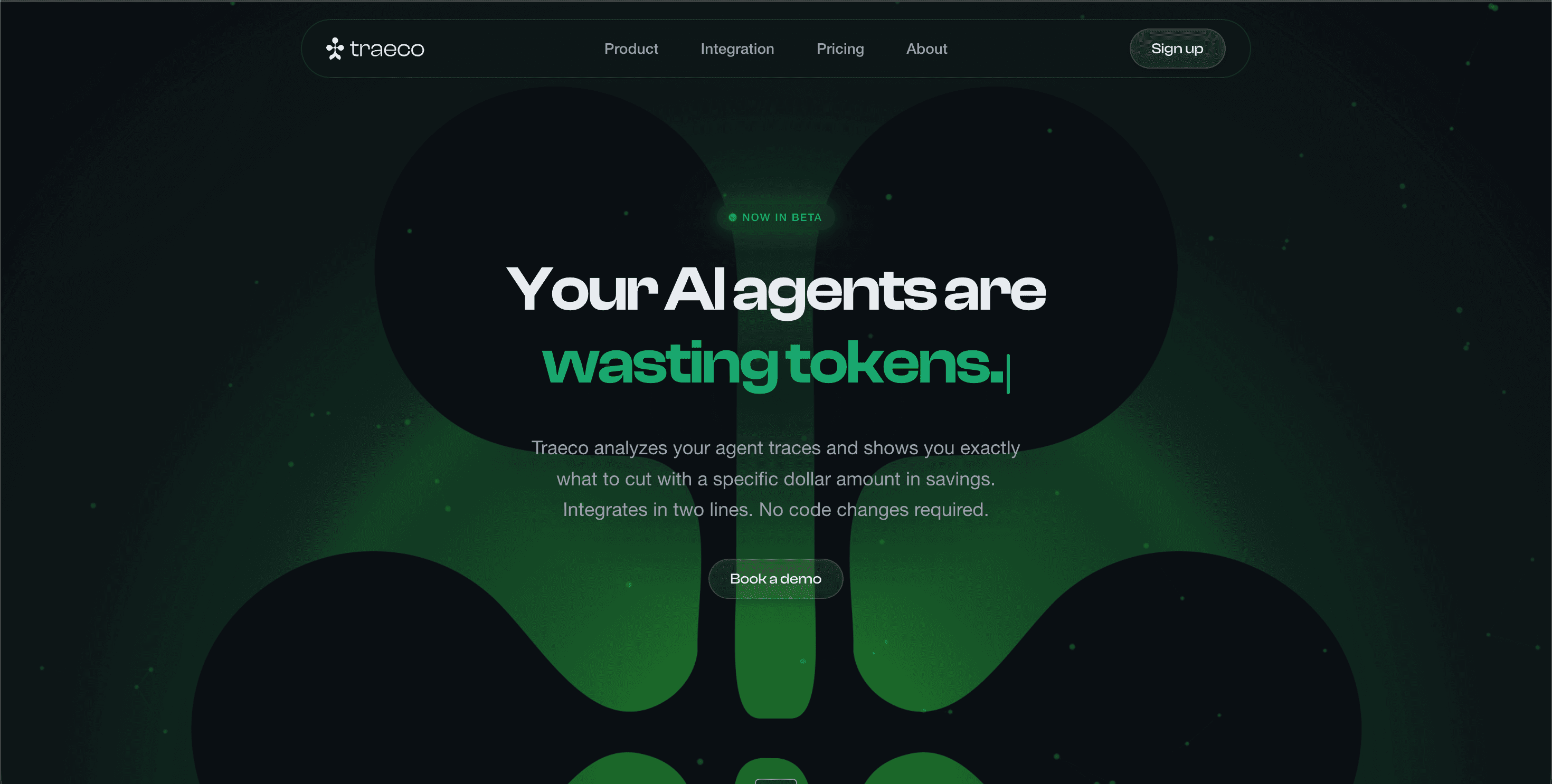
Traeco is observability and cost management for AI agents, founded with my co-founders through LavaLab, USC's largest incubator. I'm co-founder and CPO, and was the only designer: the brand, the product, the site, and the decks are all mine. Live at traeco.dev. We won Audience Choice at the closing summit. Shipped the dashboard, marketing site, and full design system to production. Conversion to action in usability tests went from 22% to 71%.
AI agents are getting expensive faster than anyone can see them.
- Alphabet posted its first negative quarterly free cash flow since its 2004 IPO, $5.9B, on $44.9B of AI capex
- Uber exhausted its entire 2026 AI budget by April and now caps engineers at $1,500 a month per tool
- Across 50+ calls in 11 industries, the teams closest to it told us it wasn't urgent yet, and that they knew it would be
We spent weeks looking for a problem before we found this one. Fifty plus calls across eleven industries: semiconductors and hardware, aerospace and defense, entertainment, AR/VR, product, architecture, branding, research, finance, data infrastructure. The last stretch of calls was entirely agentic AI, which is where we stopped. What those founders told us was more useful than agreement. Agent cost was not their most pressing problem yet. They could see it coming, and they were certain it would land on everyone. That changed the brief. Building for someone already in pain is easy, because they will tolerate friction when they are desperate. Building for someone who does not feel it yet means the product has to cost almost nothing to adopt, has to show value before there is a crisis, and has to make an invisible cost visible before anyone thinks to ask.
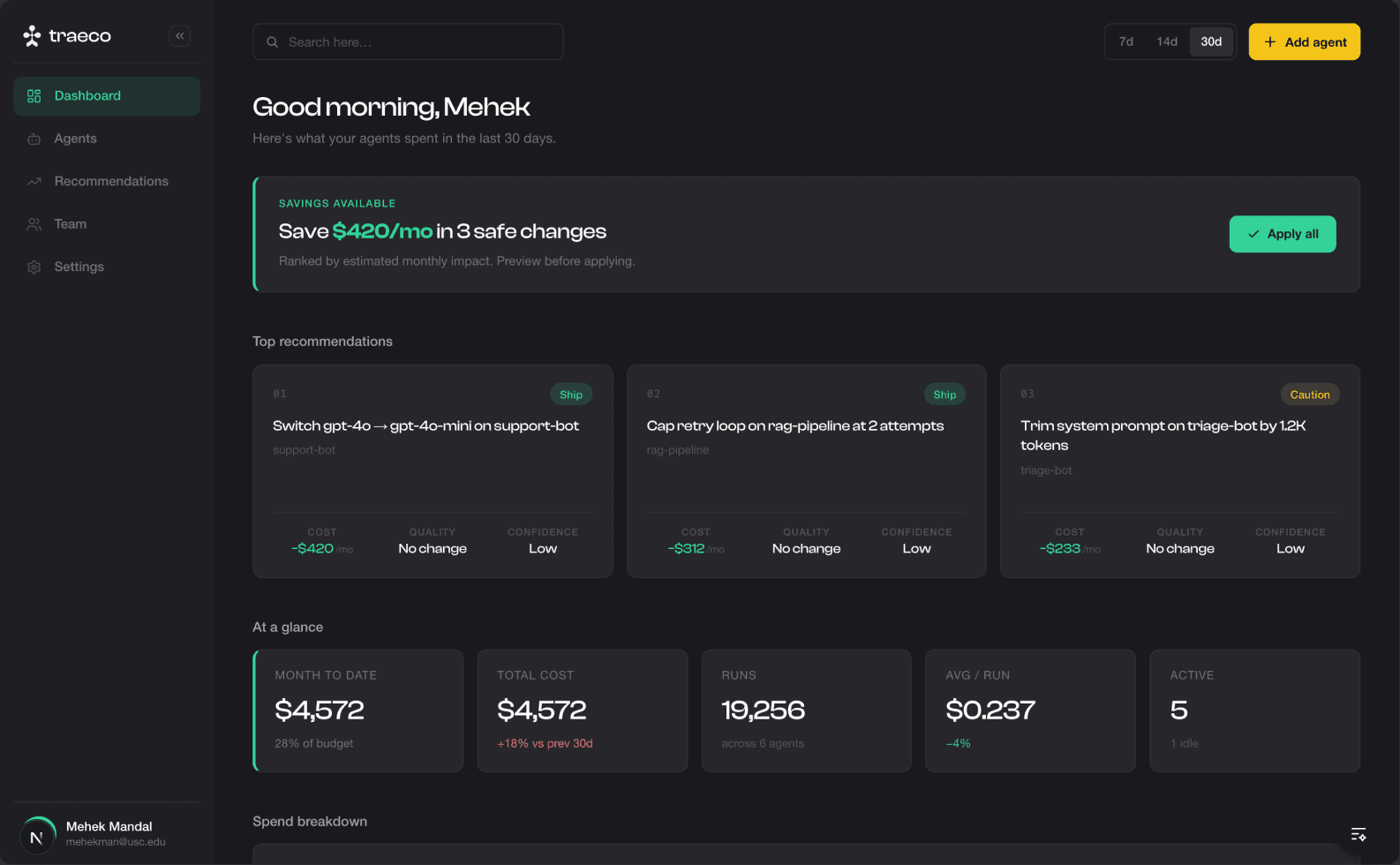
The dashboard
I scoped the dashboard against user conversations rather than a feature list. Two questions ran in parallel: what has to be here for this to be usable, and what has to be here for someone to pay for it. Those produce different lists, and the second one is shorter. The timing insight above set the constraint: this had to earn attention from people who were not yet in pain.
The brand system
Built from nothing as the only designer on the team: identity, system, and every application of it.
Two decks, two jobs
Two decks for two jobs. One built to be presented live, with us speaking over it, sparse enough that the room watches us instead of reading the slide. One built to survive alone in an investor's inbox, carrying the whole argument without a presenter. Different density, different job.
This study is being written. For the full story in the meantime, luwena@usc.edu.