Atlix
Narrative intelligence: what young Californians are actually talking about, surfaced in real time
Atlix came out of a global student startup competition based in Seoul, where we were the first team to represent USC. The brief was to empower the next generation through social media. We chose youth political engagement, in part because one of our co-founders came from a political science background, and spent the run-up validating the problem with local politicians. The final stretch was a sprint in Korea: the pitch deck, the product, and a set of design partners. We finished as finalists.

Polling and survey data lag behind
- Nobody wanted yet another data tool
- Summaries they could trust, with the source still one click away
- Cards first, summaries upfront, citations always visible
By the time a report goes out, the conversation has already shifted. I wanted to build something that listened to what young people were actually saying in real time. The product had to be useful for advocacy groups, policy researchers, and anyone who needs to read demographic discourse without waiting for a quarterly report.
The dashboard
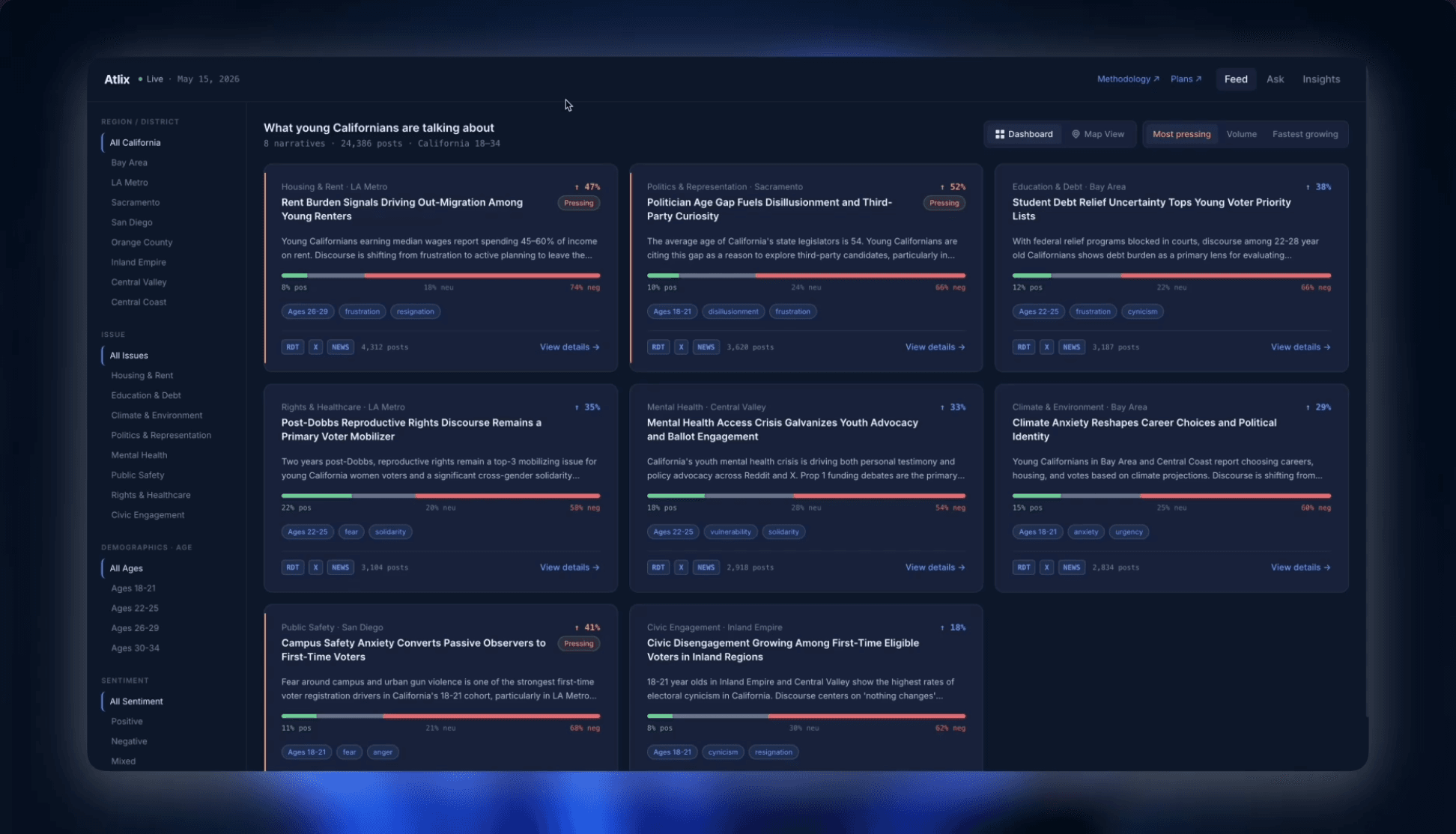
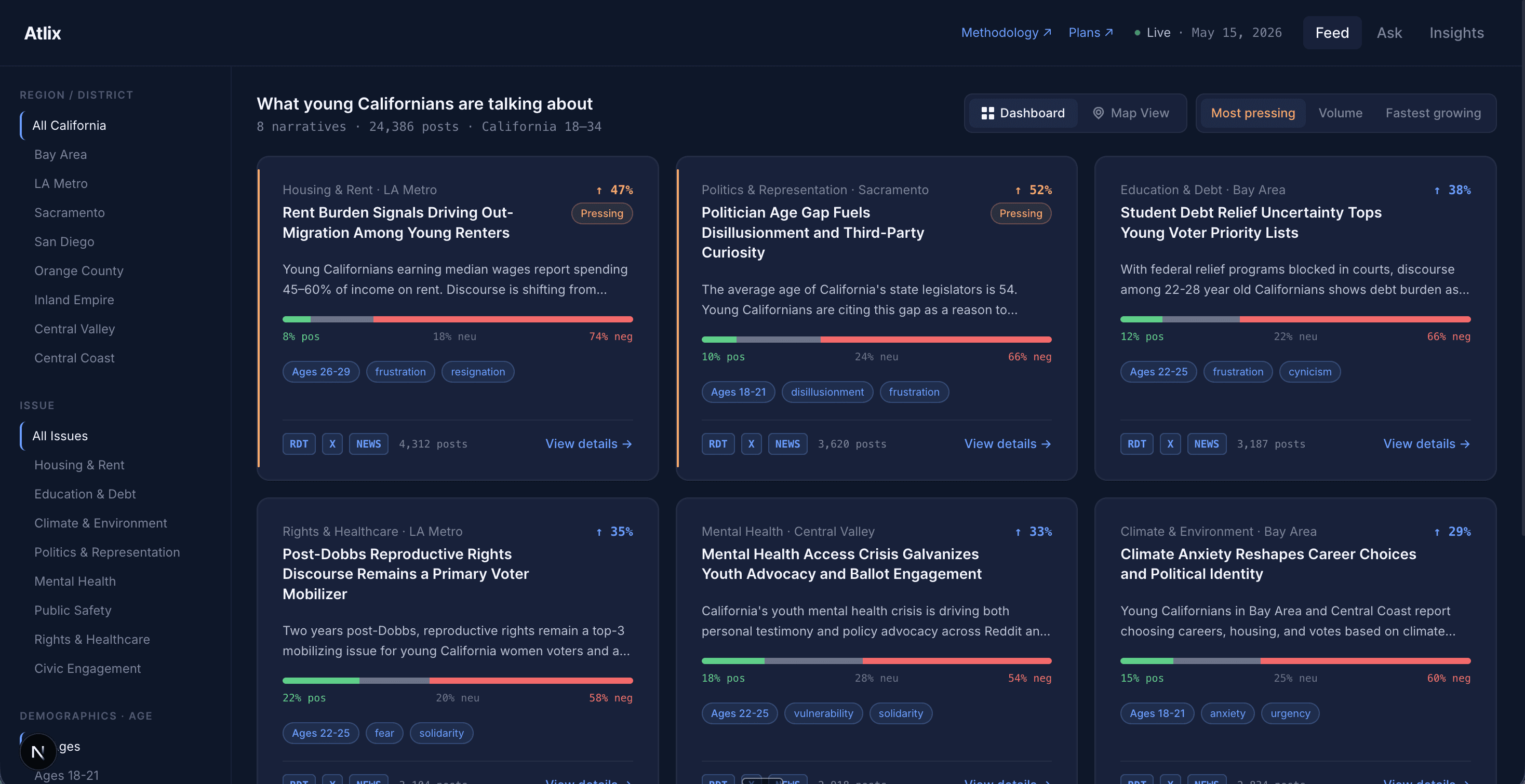
The first version was much busier: filters everywhere, charts on charts, every card trying to say too much at once. Feedback from the researchers cut it back to what actually matters in the first three seconds: what's the topic, where is it happening, how much is it growing, and who's talking about it. Left rail filters for region and issue, a tab row for sort order, and a card grid where each card commits to a single narrative.
Research before screens
A few weeks reading the kinds of reports people in this space already work from, talking to researchers and advocacy folks, and mapping out what their day actually looks like. The biggest pattern: nobody wanted yet another data tool. They wanted summaries they could trust, with the source still one click away.
Brand
Most tools in the category look either academic and beige or aggressively tech. Atlix is a third option: dark navy with a single accent, type forward, and quiet. The wordmark is a clean sans-serif because the product itself should be the loudest thing in any deck or screenshot.
Outcome
The biggest thing I learned was that research before design isn't a checkbox. Every time I shortcut it and started designing first, I had to throw work away. The reverse was also true: every conversation I had before opening Figma made the actual design work go faster, because half the decisions were already made. I also learned a lot about restraint. Cutting a field off a card felt scary at first, but it ended up making the whole grid feel more confident than adding one ever would have.
This study is being written. For the full story in the meantime, luwena@usc.edu.